
Ceramic-on-ceramic hip resurfacing: first MRI data analysis
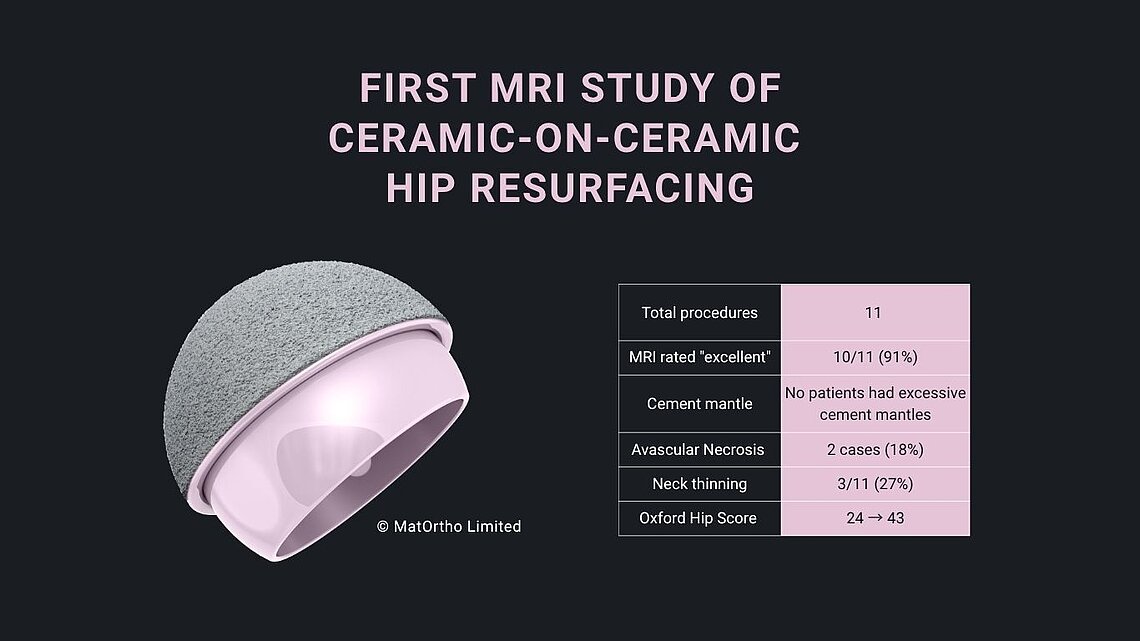
A recent study published in HIP International by Dr. Urpinder Singh Grewal, Nicholas Wambeek, Piers Yates (Australia)* et al. is the first of its kind to assess the MRI viability of BIOLOX®delta ceramic-on-ceramic (CoC) hip resurfacing.
The authors reviewed 9 patients who underwent a ReCerf® resurfacing (MatOrtho Ltd) procedure that took place between 2020 and 2023 and conducted a post-operative MRI.
The 9 patients (6 women, 3 men) were an average of 46.8 years old at time of surgery. 2 patients had bilateral surgery. 11 procedures were analyzed. Follow-up ranged from 13-56 months, with a mean of 37 months (mean post-op OHS = 46).
Study findings
- 10 out of 11 MRI scans (91%) were rated “excellent,” meaning all parameters were visible without metal artifact, allowing for more precise assessment of bone vascularity and prosthesis-cement-bone interface. Additionally, 10 of 11 described recovery as “uneventful.” In one case, a metal screw in situ compromised the quality.
- At an average of 37 months post-op, the mean Oxford Hip Score (OHS) rose from 24 to 43 (out of 48).
- In metal-on-metal HRA, femoral neck thinning is reported in 77-98% of cases. In this CoC series, stable, asymptomatic thinning was observed in only 27%. Whether this difference is material to long-term outcomes will require larger series.
- AVN features were identified in two cases (18%). One patient remained completely asymptomatic, with a perfect OHS of 48.
- While two cases showed incomplete seating (>2mm gap) on initial post-op radiographs, both demonstrated full osseointegration by 24 months.
- No revisions or dislocations were reported in this series.
According to the authors, the demonstrated compatibility of BIOLOX®delta ceramic and MRI, allowing for early detection of AVN or cement mantle issues, gives CoC a potential diagnostic advantage over MoM.
Please check for regulatory approval in your country.
This text reflects CeramTec’s summary of a peer‑reviewed scientific publication and does not constitute clinical guidance or product‑related recommendations. This post was drafted with AI assistance and approved by CeramTec.
*Piers Yates is a paid consultant for MatOrtho Ltd.[MT1]
📖 Grewal US, Wambeek N, Yates P. Ceramic resurfacing: postoperative magnetic resonance imaging and clinical outcomes. HIP International 2026. doi:10.1177/11207000251394257.