
Ceramic-on-ceramic vs. polyethylene-bearings in THA: what can 120,000 hips tell us?
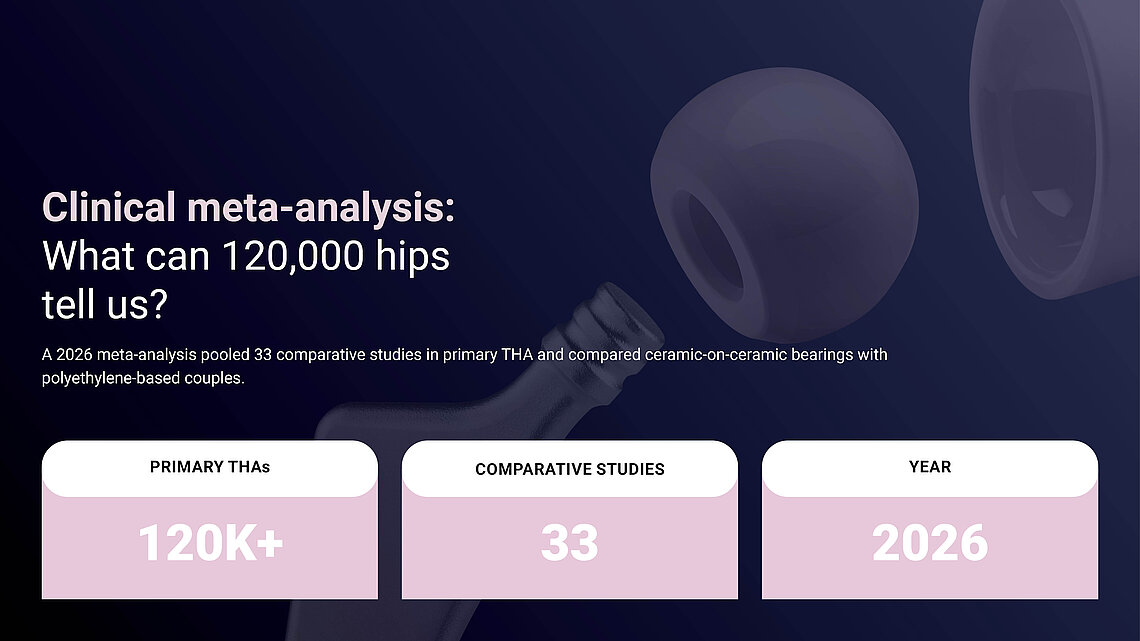
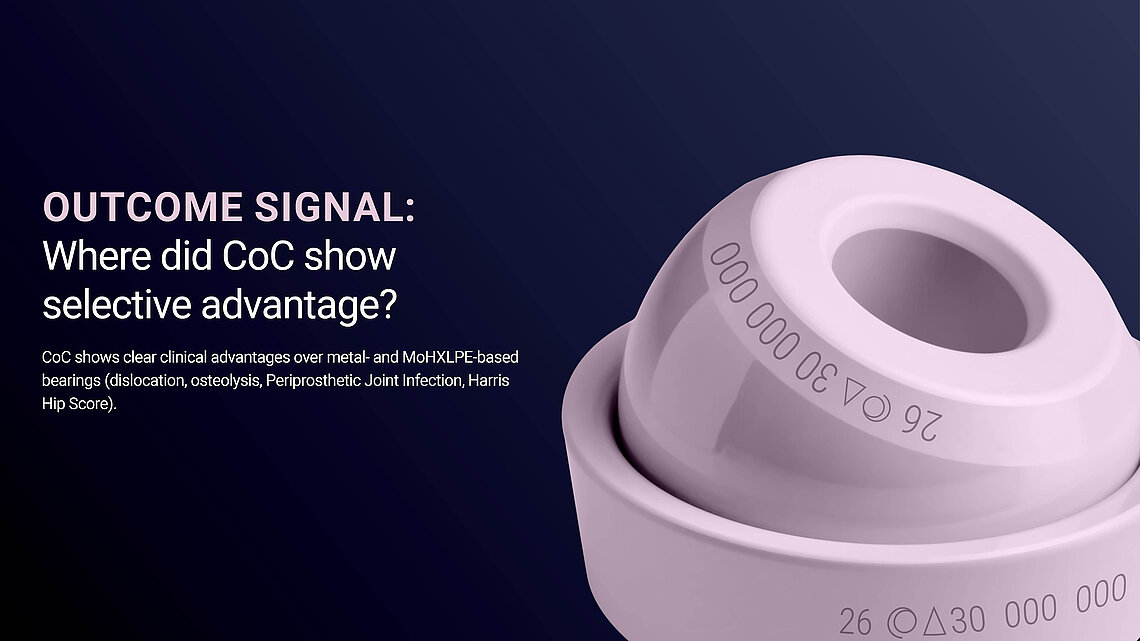

Across all studies, ceramic-on-ceramic (CoC) bearing couples were compared to metal-on-polyethylene (MoP), metal-on-highly cross-linked-PE (MoHXLPE), ceramic-on-PE (CoP), and ceramic-on-HXLPE (CoHXLPE) couples.
Note: The majority of studies in this meta-analysis reported on the performance of BIOLOX® advanced ceramic technologies manufactured by CeramTec.
That said, this is an inherently complex comparison, measuring short-term results against long-term through pooled fixed- and random-effects analyses and varying in scope, patient population, and follow-up duration. Therefore, it is difficult to draw wide-ranging objective conclusions from the data.
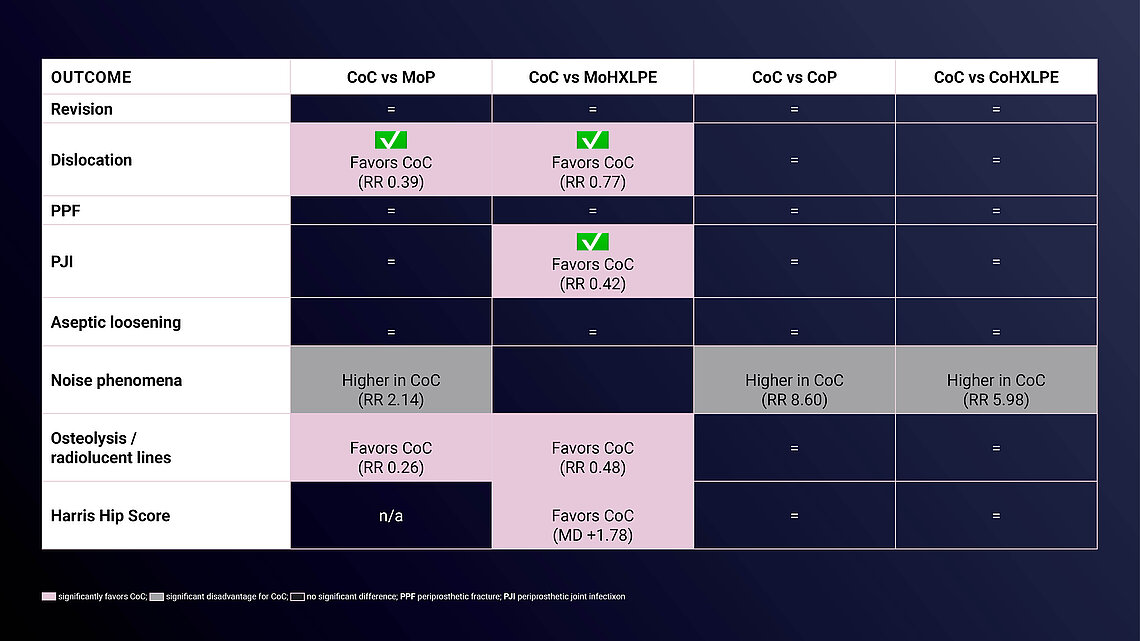
Survivorship & revision: Revision rates, aseptic loosening, and periprosthetic fracture were statistically comparable across all four comparisons. Survivorship remained consistent throughout, although Kaplan-Meier scores revealed a consistent numerical advantage favoring ceramic-on-ceramic: Vendittoli et al. (2021) reported 20-year survivorship of 96.9% for CoC versus 73.6% for MoP.
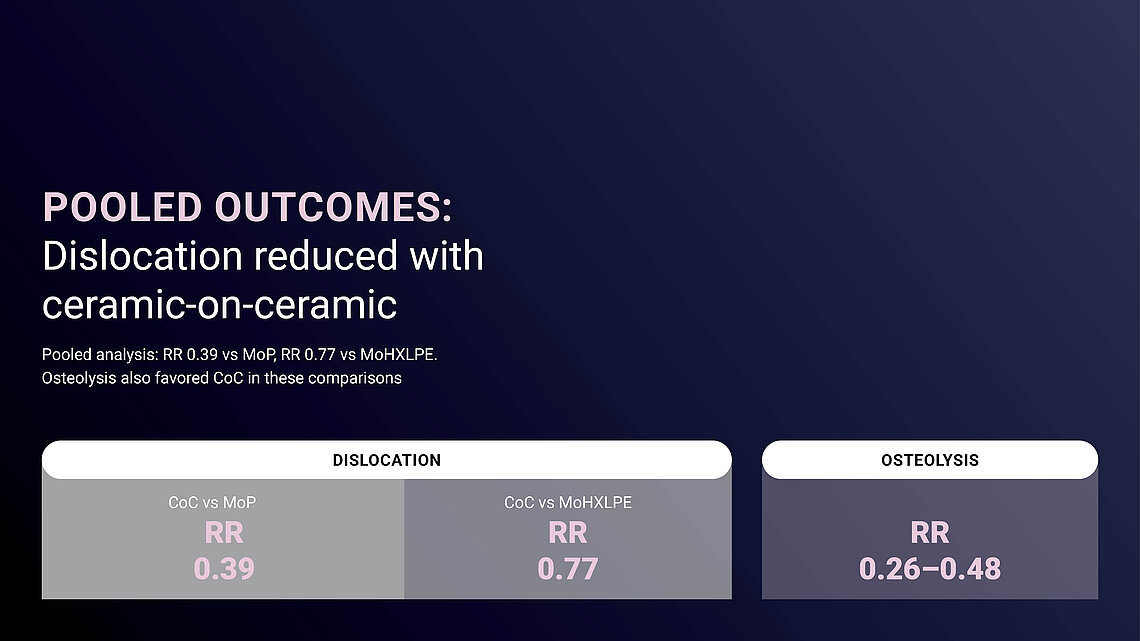
Dislocation: CoC significantly reduced late prosthetic dislocation versus MoP (RR 0.39, p = 0.05) and vs. MoHXLPE (RR 0.77, p = 0.004). No statistically significant difference between the CoC and CoHXLPE groups (p = 0.38).
Osteolysis: Lower incidence of osteolysis and radiolucent lines with CoC versus MoP (RR 0.26, p = 0.02) and MoHXLPE (RR 0.48, p = 0.004). This is consistent with the extremely low wear rates of modern ceramic couples. No statistically significant difference between the CoC and CoHXLPE groups (p = 0.54).
Infection: PJI was broadly comparable, with the notable exception of a significantly lower pooled PJI rate for CoC versus MoHXLPE (RR 0.42, p < 0.00001). CoC and CoHXLPE returned no statistically significant difference (p = 0.4).
Function:Broadly equivalent across bearings. In the CoC-versus-MoHXLPE subgroup, CoC showed a modest edge in Harris Hip Score (MD 1.78, p = 0.0009) and WOMAC (MD –6.16, p = 0.005).
Trade-off: Noises were most frequent with CoC, but were also detected with other bearings – MoP (RR 2.14), CoP (RR 8.60), and CoHXLPE (RR 5.98).
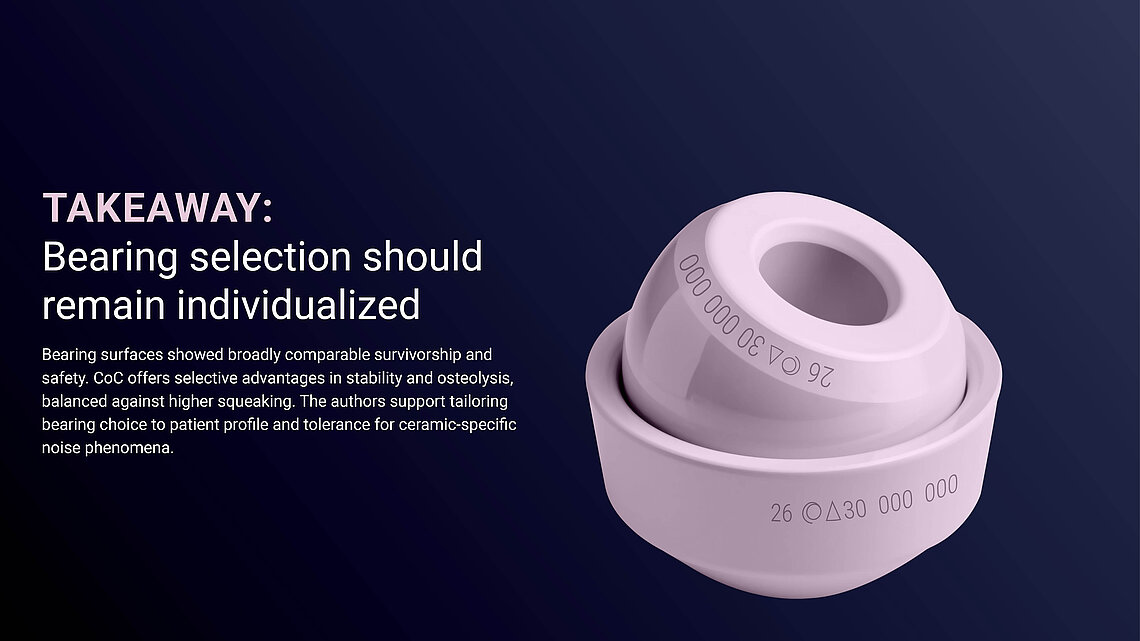
Ceramic bearings (CoC and CoHXLPE) present distinct advantages over metal bearings. The authors conclude that bearing selection remains part of the surgeon’s medical decision making and should be tailored to patient age, activity demands, and tolerance for ceramic-specific noise phenomena.
Please check for regulatory approval in your country.
References: Boutros M, Awad G, Bou Hamdan K, Rubin L, Mansour E. Ceramic-on-ceramic versus polyethylene-based bearings in total hip arthroplasty: A meta-analysis. European Journal of Orthopaedic Surgery & Traumatology, 36, 239. doi: 10.1007/s00590-026-04825-8