
How do bearing-surface choices in total hip arthroplasty perform across patient age and follow-up duration?
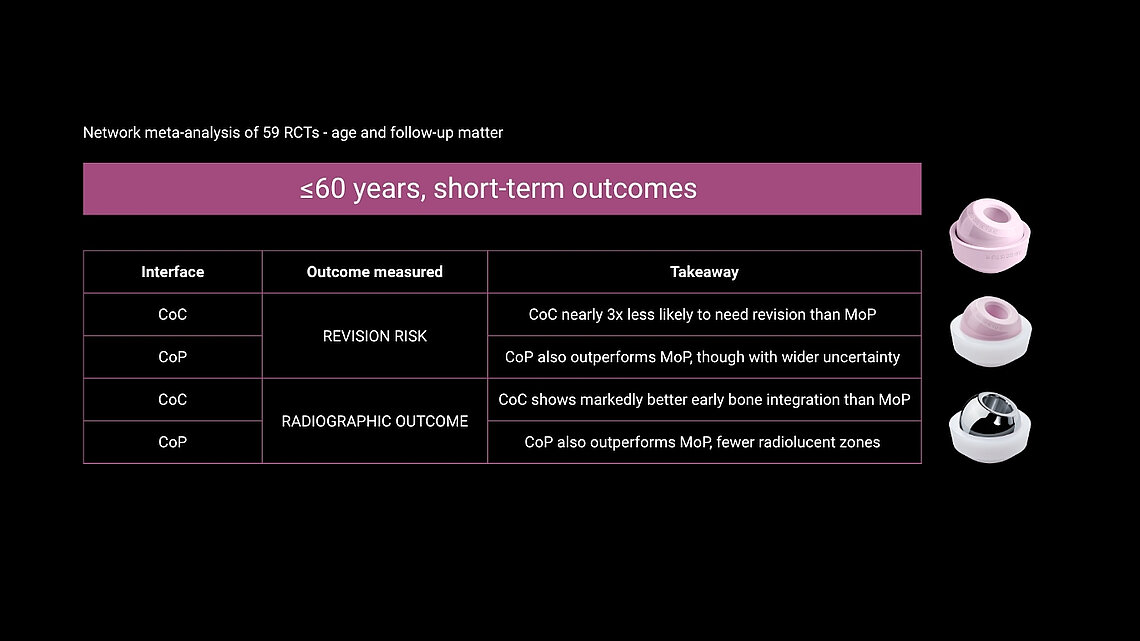
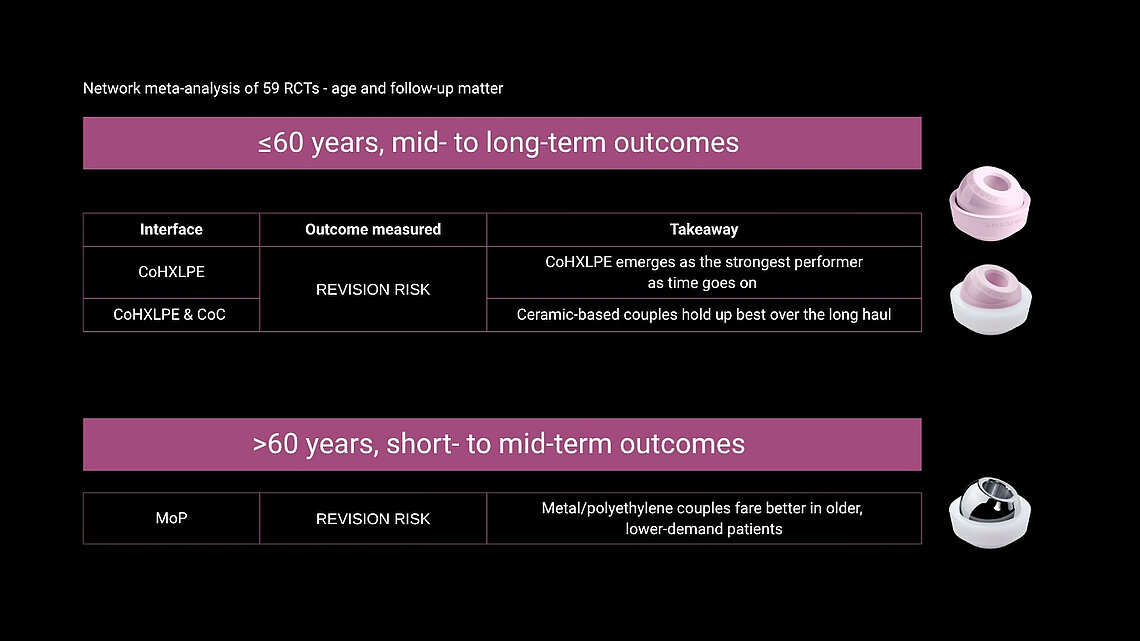
A new network meta-analysis by Liang et al., published open-access in Medicine (2026), synthesizes 59 RCTs to compare prosthetic interfaces in THA – stratified by patient age (up to 60 years vs. older) and follow-up duration (short-term ≤5 years, mid-term 5-15 years, long-term ≥15 years).
Bearings evaluated included ceramic-on-ceramic (CoC), ceramic-on-polyethylene (CoP), ceramic-on-highly cross-linked polyethylene (CoHXLPE), metal-on-polyethylene (MoP), metal-on-metal (MoM), and metal-on-HXLPE (MoHXLPE).
The highlights: |
|
The authors conclude that prosthetic selection should be tailored to age. For younger, more active patients, ceramic bearings (CoC and CoHXLPE) offer the strongest combination of wear resistance, radiographic performance, and long-term survivorship. CoHXLPE demonstrated durability across age groups and follow-up windows, reinforcing the role of ceramic heads in extending the working life of modern THA constructs.
Study limitations (as noted by the authors): Heterogeneity across the included, indirect RCTs – in surgical technique, implant design, and outcome reporting – may influence pooled estimates. Several subgroups, notably long-term and older-patient strata, were underrepresented in trials, limiting statistical power. There were also no patient-level adjustments for BMI, bone quality, or activity.
Additionally, the authors have included studies on OXINIUM (Smith & Nephew) and oxidized zirconium in the ceramic group, joining a list of several papers that compare OXINIUM-on-polyethylene with CoCr-on-polyethylene.
The authors stress the need for further long-term RCTs to reduce heterogeneity and bias and to confirm these age-stratified trends.
Read the full study: https://doi.org/10.1097/MD.0000000000049085
📖 Liang Q, Li Y, Guo W, You D, Qin L, Xu M. Comprehensive outcomes of different prosthetic interfaces in total hip arthroplasty: A network meta-analysis and systematic review based on age and follow-up periods. Medicine, 105(23), e49085. doi: 10.1097/MD.0000000000049085