
Metal release in knee replacement: “under-studied and poorly understood”
Unlike in hip implants, there are no widely accepted thresholds for metal concentration in knee implants. Despite knee implant components’ dependency on metal, the biological effects of metal wear debris and previous revisions are understood far less than in the hip.
This group of surgeons and researchers sought to address this discrepancy by identifying significant knowledge gaps and practical takeaways:
- What are the metal concentrations reported in patients after TKA?
- What metal ion levels do studies use as clinically relevant thresholds?
- Does implant design affect metal concentrations in vivo?
The method
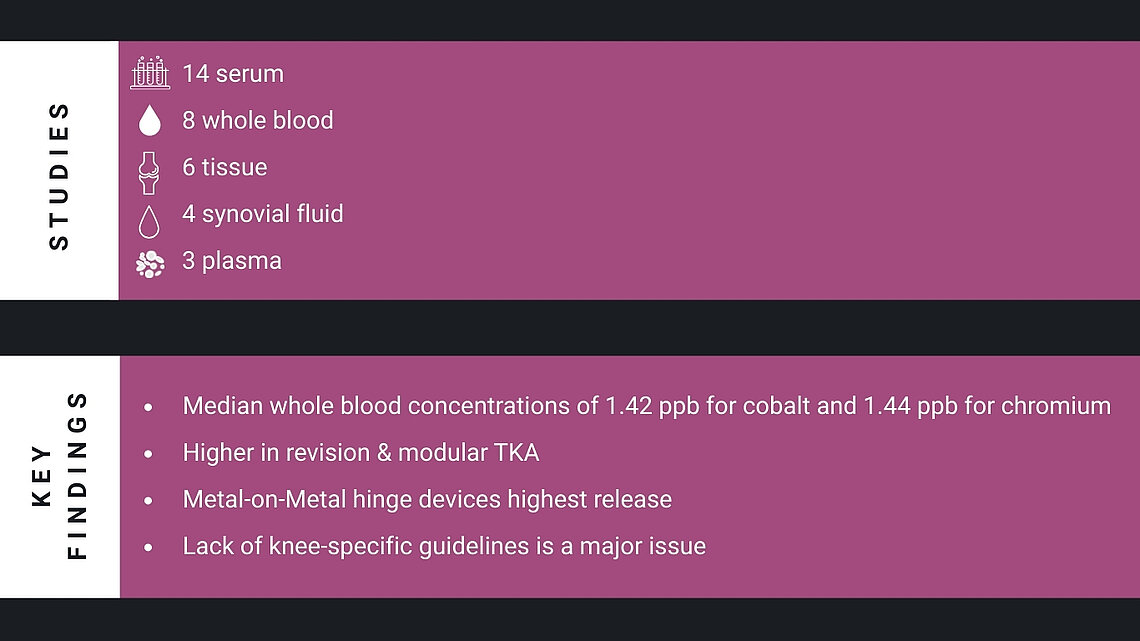
33 studies were screened using a modified Newcastle-Ottawa quality assessment scale. 14 studies focused on serum, 8 on whole blood, 6 on tissue, 4 on metal ion concentrations in synovial fluid, and 3 on plasma.
The findings
- Median whole blood concentrations of 1.42 ppb for cobalt and 1.44 ppb for chromium in TKA patients. Periprosthetic tissue generally had higher concentrations. These in turn led to more incidences of implant damage and loosening, as well as ALVAL.
- Most studies use a metal release threshold of ≥2 ppb, often derived from total hip arthroplasty (THA) guidelines. The authors recognize that the lack of knee-specific guidelines is a major issue.
- Revision and modular TKA measured significantly higher cobalt and chromium concentrations in whole blood compared to primary and monobloc TKA (P < 0.05).
- Metal-on-metal (MoM) hinge devices were specifically noted for their high Co and Cr concentrations.
Drs. Mihalko, Mont, and Kurtz stress that metal ion release is a reality in TKA and that surgeons should treat this trade-off with caution when considering the stability of constrained devices. Furthermore, bearings that use alternative materials to MoM hinges may be an increasingly viable means of avoiding the high metal debris concentrations documented in this study.
Please check for regulatory approval in your country.
This text was created with the support of AI.
References:
Aslani S, Kurtz M, Spece H, Mont M, Mihalko W, Kurtz S. Systematic Review of Metal Concentrations in Blood, Serum, and Tissue Following Primary and Revision Total Knee Arthroplasty. J Arth, September 3, 2025. doi: 10.1016/j.arth.2025.08.078