
Outcomes of revision for ceramic fracture in Dual Mobility implants with a metallic inner head
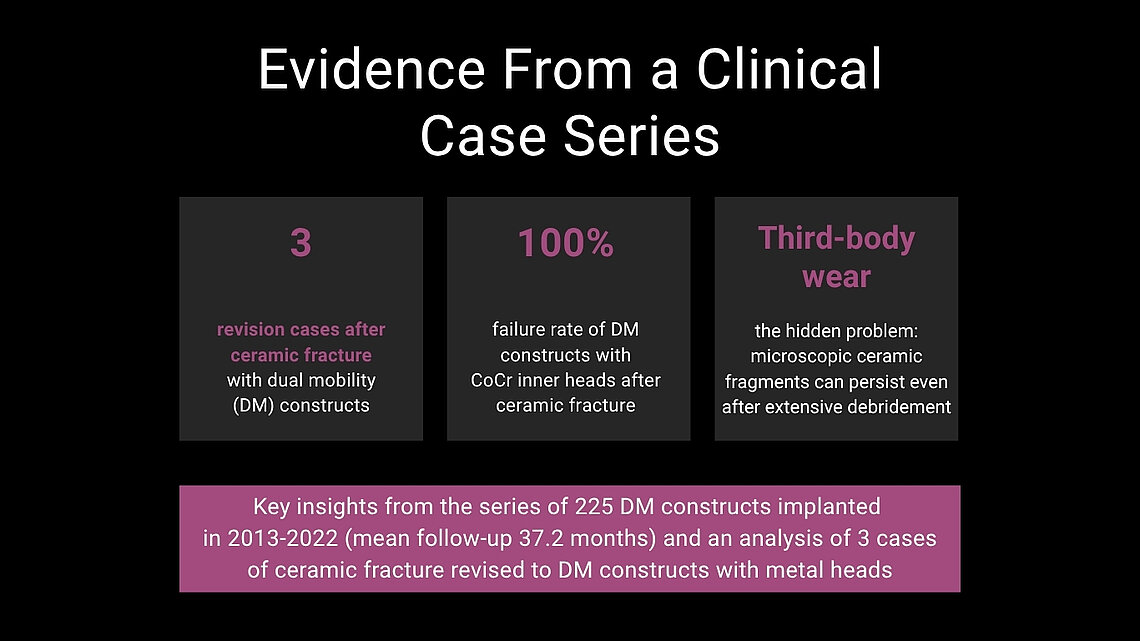
A case report from Garcia-Rellan et al. (University Clinical Hospital, Valencia) in @Acta Orthopaedica Belgica reviewed 225 dual-mobility (DM) constructs with a CoCr inner head implanted from January 2013-January 2022. Three cases (1.3%) involved revision after ceramic fracture using CoCr-inner-head DM constructs.
Despite extensive debridement, synovectomy, & lavage at time of revision, microscopic ceramic fragments remained in the joints and became embedded in the polyethylene surfaces, accelerating third-body wear of the metal components (far more pronounced on the metal head than on the insert).
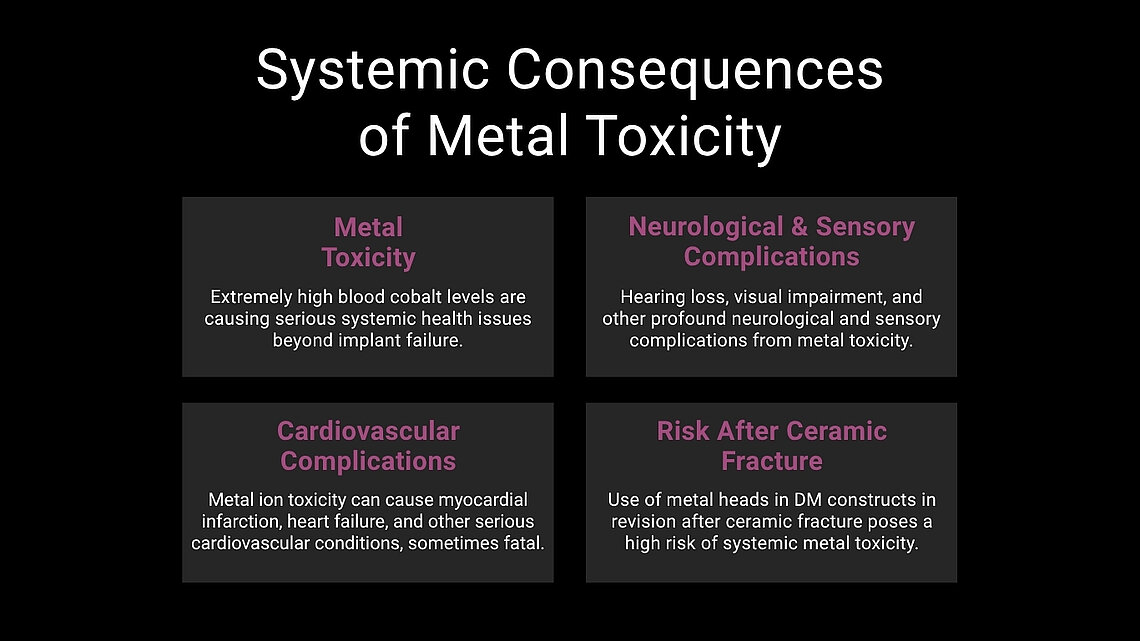
| Case 1 | A 64-year-old man revised after ceramic fracture at 125 months post-index THA. Within 8 months he developed fatigue, anorexia, hearing loss, & visual impairment. Cobalt levels in the blood reached 1308 µg/L, chromium levels 17 µg/L. He suffered a pulmonary embolism. After construct removal & chelation therapy, his hearing partially improved, but bilateral scotoma & macular atrophy persisted. He declined the planned second-stage reimplantation. |
| Case 2 | A 55-year-old woman revised after a ceramic microfracture due to neck impingement. Within months she developed nausea, tinnitus, & dizziness, followed by an acute myocardial infarction at 4 months. Cobalt (760 µg/L) and chromium (100 µg/L) blood levels were elevated. The patient was revised to a ceramic-on-ceramic bearing. Despite satisfactory outcomes, she required a cochlear implant for severe hearing loss and retained moderate visual impairment. |
| Case 3 | A 54-year-old man revised after ceramic fracture at 9 years. He developed progressive hearing loss, pericardial effusion, & systolic dysfunction. Cobalt blood level was 980 µg/L, chromium blood level 82 µg/L. Revision surgery was proposed but could not be performed due to critical cardiac status. He died from heart failure. |
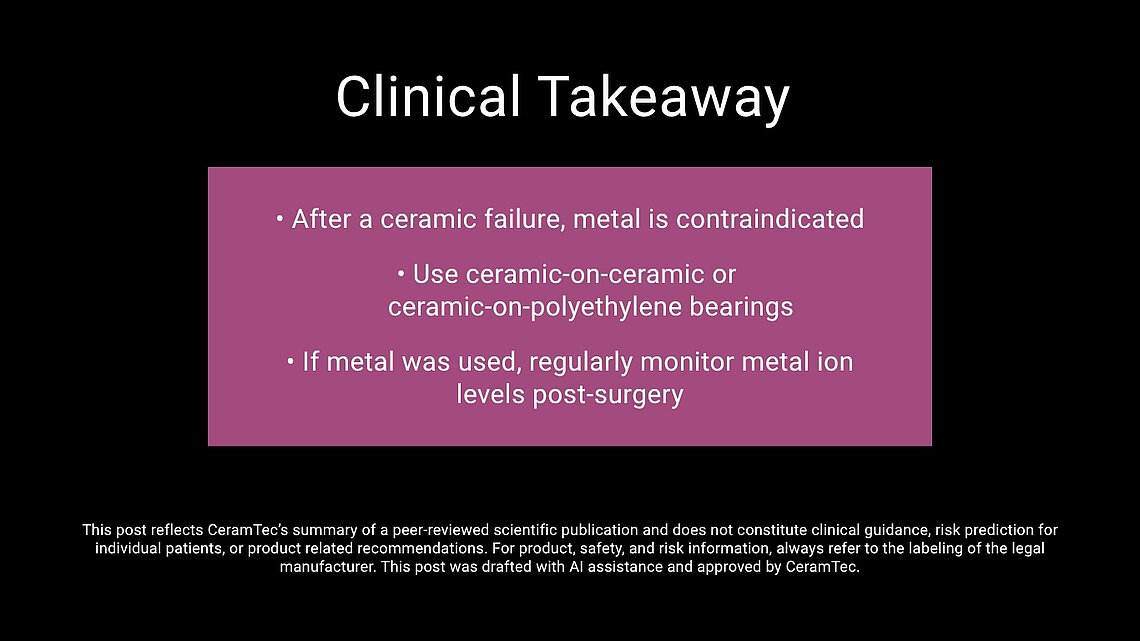
These findings apply exclusively to modular DM constructs with a CoCr inner head implanted after ceramic fracture, a specific high-risk scenario. In standard DM use, large contemporary series consistently report low serum metal ion levels regardless of bearing configuration. But in the context of ceramic fracture revision, the authors caution against the usage of metal heads. Retained ceramic debris may accelerate metal wear & systemic toxicity. The authors favor CoC or CoP bearings for revision after meticulous debridement, with serial metal-ion monitoring. This report confirms why metal bearings after the rare incidence of ceramic fracture are contraindicated.
Please check for regulatory approval in your country.