
Pentland et al. (2026) review 30-year survivorship of modern total hip replacement
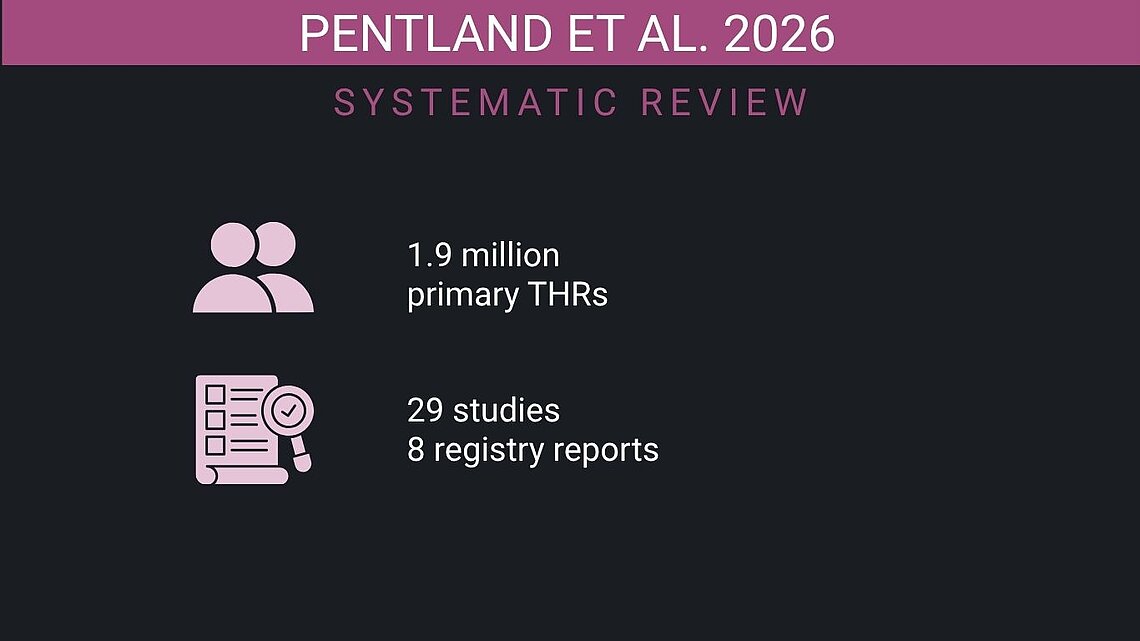
The analysis includes data from the 2024 National Joint Registry report (UK) as recorded by Whitehouse et al., which speaks to excellent long-term survivorship for ceramic – and the low risk of revision presented by BIOLOX®delta ceramic bearings specifically. This finding carries weight as younger patients undergo primary THR and implant longevity expectations surpass 25 years.
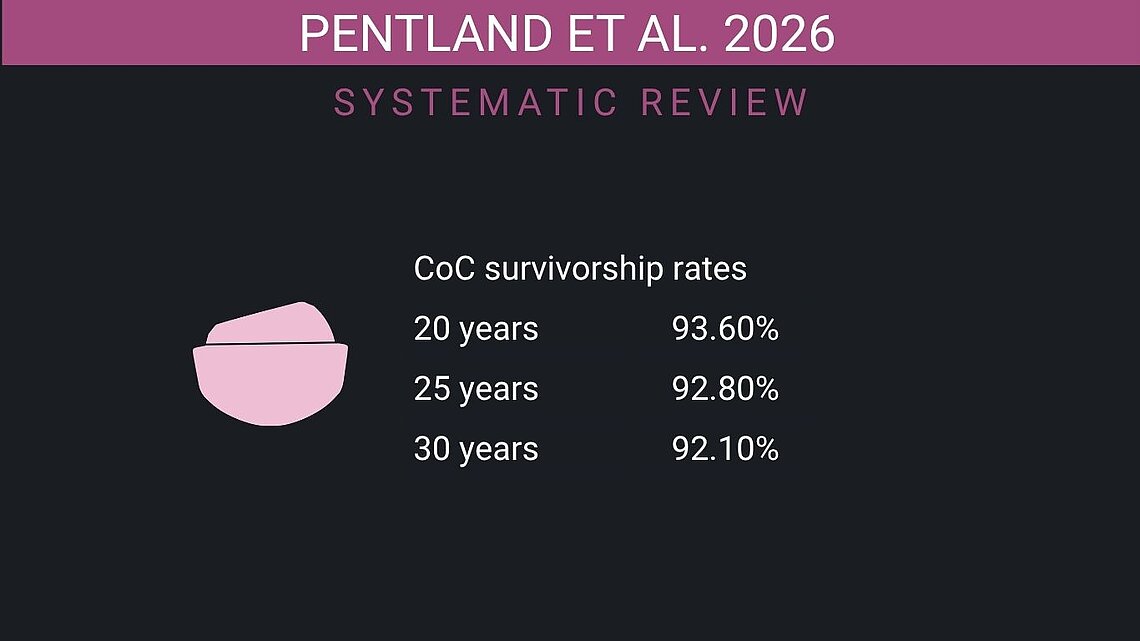
Modern bearings returned to a predicted survivorship rate of 92.1% at 30 years, compared to 57.9% at 25 years for older bearings (Evans et al. 2019). This gap reflects what two decades of bearing surface development have delivered.
What are “modern bearings”?
Every hip analyzed in this reviewused one of three contemporary bearing couples:
- Ceramic-on-ceramic: 3rd-generation alumina (BIOLOX®forte) or 4th-generation zirconia-toughened alumina (BIOLOX®delta)
- Ceramic-on-XLPE: the same ceramic heads paired with highly cross-linked polyethylene
- Metal-on-XLPE
Key findings
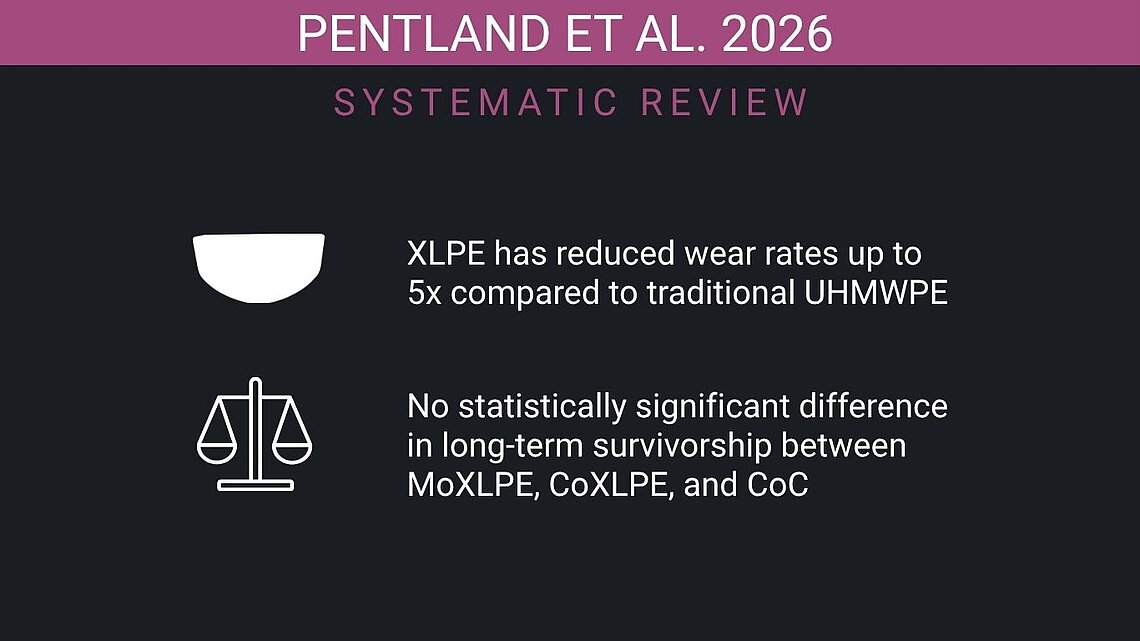
While no statistically significant difference in long-term survivorship was found between bearing couples in either meta-analysis or registry data, CoC returned the tightest confidence interval – a spread of 1.88 percentage points, versus 5.05 for CoXLPE. From the meta-analysis:
| Bearing couple | Survivorship (95% CI) |
| CoC | 97.05% (95.97-97.85) |
| CoXLPE | 96.29% (93.01-98.06) |
| MoXLPE | 97.14% (94.82-98.44) |
Across 110,883 hips, with 94.5% survivorship at 20 years, CoC’s narrow CI suggests consistency across registries, patient populations, and surgical settings. When survivorship is comparable, predictability becomes the differentiator.
What’s driving improvement across all three couples?
The paper identifies two specific advances:
- XLPE reduced wear rates up to 5x compared to traditional UHMWPE – directly reducing aseptic loosening and revision rates across XLPE-based couples.
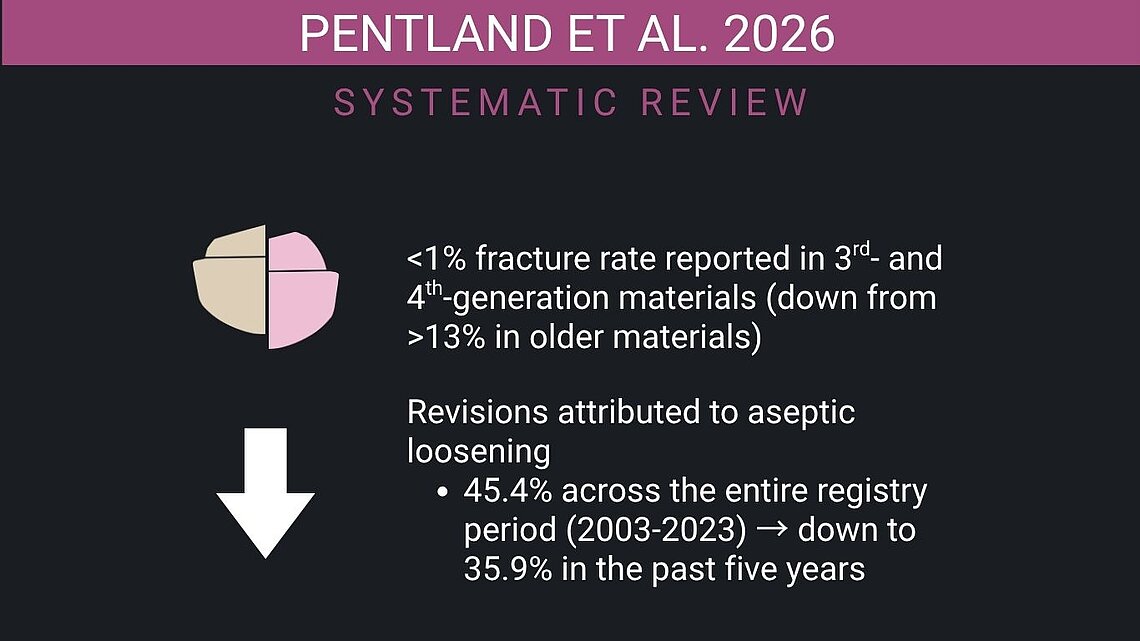
- The 2024 NJR report recorded a fracture rate of <1% in 3rd- and 4th-gen ceramic – down from >13% in earlier generations. The authors link these advances to a 50% reduction in UK revision rates from 2008-2023.
Revisions attributed to aseptic loosening fell from 45.4% across the full 2003-2023 registry period to 35.9% in the last five years.
For comparable survivorship data, the clinical question shifts to fracture risk profile, patient age, metal sensitivity, and implant predictability over a 30-year horizon.
Please check for regulatory approval in your country.
References
📖 Pentland V, Thompson Z, Dayimu A, et al. Survivorship of modern total hip replacement to 30 years: systematic review, meta-analysis, and extrapolation of global joint registry data. Lancet. 2026;407(10531):855-866. doi:10.1016/S0140-6736(25)02305-0.
📖 Whitehouse MR, Patel R, French JMR, et al. The association of bearing surface materials with the risk of revision following primary total hip replacement: A cohort analysis of 1,026,481 hip replacements from the National Joint Registry. PLoS Med. 2024;21(11):e1004478. doi:10.1371/journal.pmed.1004478
📖 Evans JT, Evans JP, Walker RW, Blom AW, Whitehouse MR, Sayers A. How long does a hip replacement last? A systematic review and meta-analysis of case series and national registry reports with more than 15 years of follow-up. Lancet 2019; 393: 647–54.
This post reflects CeramTec’s summary of a peer‑reviewed scientific publication and does not constitute clinical guidance or product‑related recommendations. This post was created with the support of AI