
What does the best available evidence tell us about BIOLOX®delta 4th-generation ceramic bearings in total hip arthroplasty?


The numbers are worth reading carefully.
Out of every 1,000 patients with a hip made of BIOLOX®delta ceramic:
- <4 patients require revision for periprosthetic joint infection (PJI) – one of the most devastating and costly complications in arthroplasty.
- ~4 patients may experience audible squeaking, but almost none require reoperation for it.
- <1 patient required revision due to ceramic fracture.
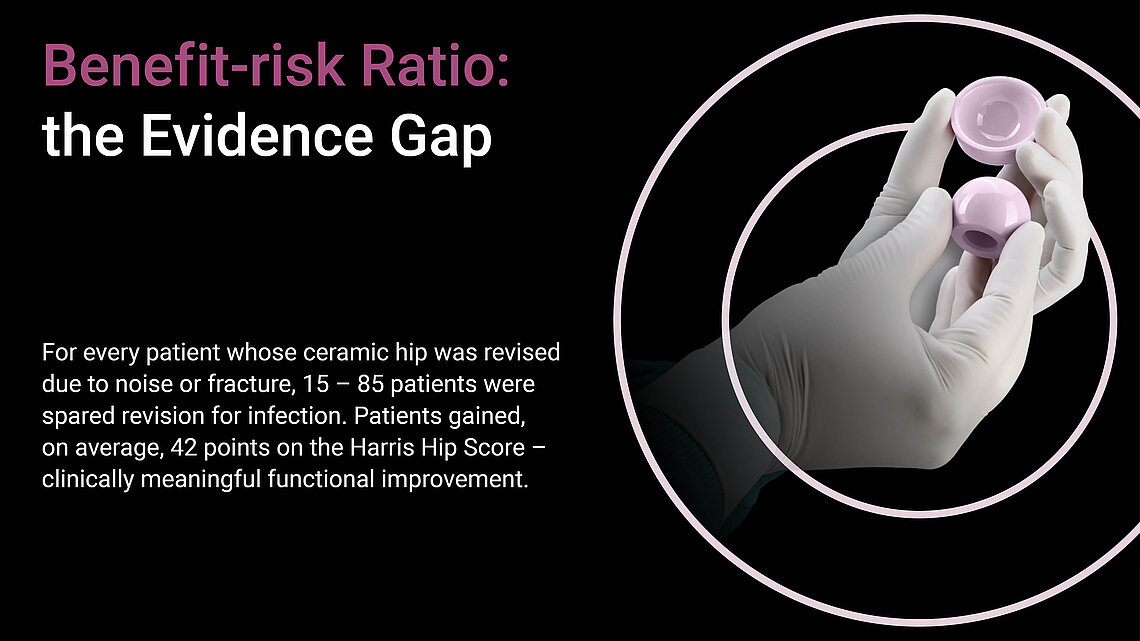
- For every patient whose ceramic hip is revised because of noise or fracture, 15-85 patients are spared revision for infection.
This is what the data say across registries, RCTs, and cohort studies on three continents.
Patients also gained, on average, 42 points on the Harris Hip Score (HHS) from baseline to latest follow-up – a clinically meaningful functional improvement – with no marked difference between bearing materials (CoC, CoP, MoP).
The evidence also raises a harder question: why does a patient in Sweden receive a metal bearing 70% of the time, while a similarly diagnosed patient in Germany of the same age and BMI receives a ceramic bearing 70% of the time? That 60-point gap is explained less by science than by habit, procurement patterns, and provider preference. In a field where bearing choice demonstrably affects long-term outcomes, it’s a conversation worth having openly and urgently.
A note on interpretation: these findings describe BIOLOX®delta ceramic technology specifically, defined by its microstructure, manufacturing precision, and over two decades of clinical scrutiny. Evidence generated with one ceramic does not transfer to another. In orthopedics, as in any evidence-based discipline, the data follow the implant, not the label.
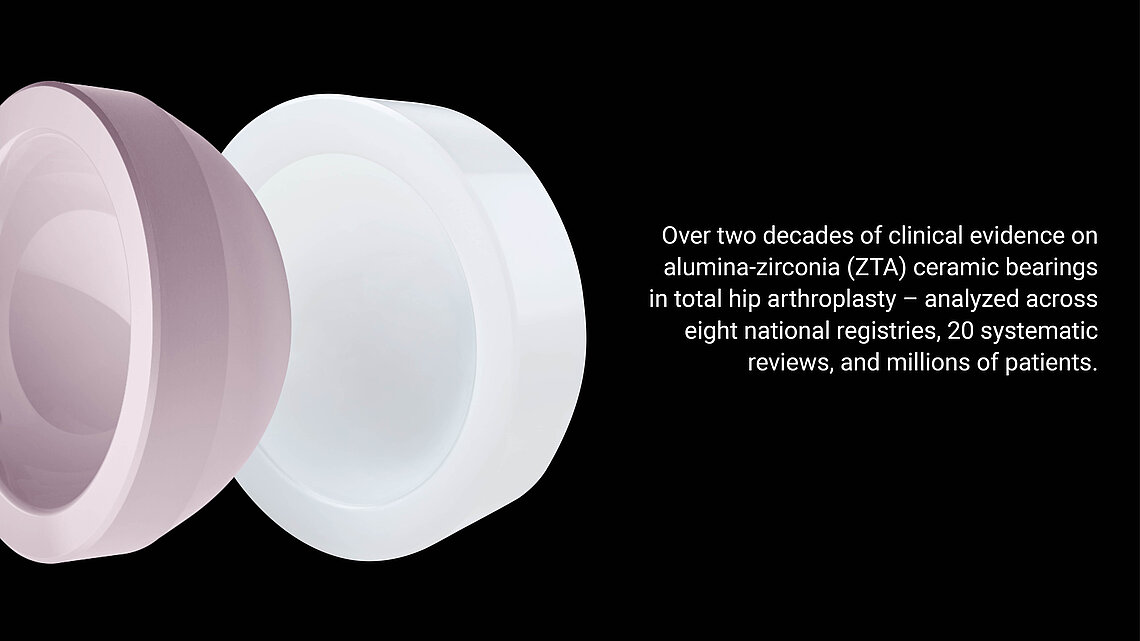
BIOLOX®delta is that ceramic. On the market since 2003, with 20+ million components distributed worldwide, it remains one of the most extensively documented ZTA ceramics in clinical use.
Discover the evidence: https://pmc.ncbi.nlm.nih.gov/articles/PMC11297405/
📖 Perka C, Mohaddes M, Zagra L, Ekkernkamp A, Keller N, Stengel D. May the 4th be with you: mixed-methods best-evidence synthesis on 4th-generation alumina–zirconia ceramic bearings in total hip arthroplasty. EFORT Open Rev. 2024;9(7):632–645. doi: 10.1530/EOR-23-0218