
What implications does implant material choice carry beyond the joint itself?
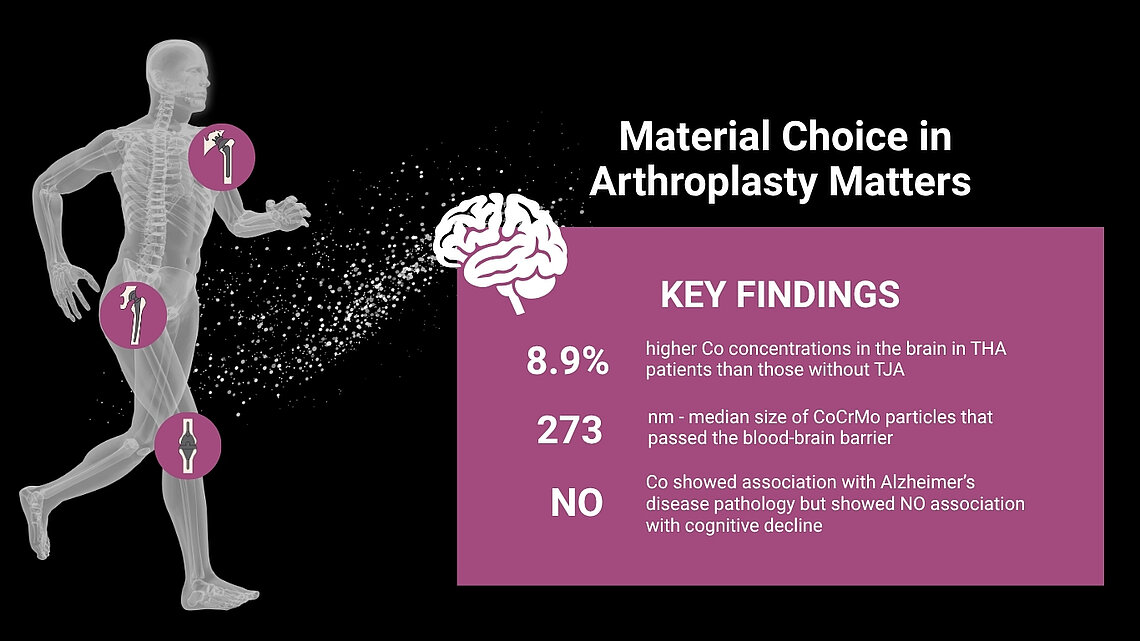
A team at Rush University Medical Center set out to answer these questions. Prof. Robin Pourzal, Nadim Hallab, and colleagues examined brain tissue from 701 autopsied older adults enrolled in the Rush Memory and Aging Project. This is one of the largest studies of its kind.
229 participants had undergone total joint arthroplasty (TJA). The investigators measured cobalt and titanium concentrations across four brain regions using ICP-MS and then looked for associations with Alzheimer's disease pathology.
The findings:
- THA patients had 8.9% higher cobalt concentrations in the brain than those without TJA (p = 0.002) – not a subtle signal.
- SEM/EDS analysis identified likely implant-derived metal particles (including CoCrMo (median size 273 nm) and TiAlV (median size 375 nm)) in the brain tissue of 9 out of 11 total hip arthroplasty (THA) patients.
- Despite the presence of nanoscale metal particles in brain tissue, histological analysis showed no detectable local inflammatory reaction in any of the affected cases.
- The authors suggest a “Trojan horse” mechanism: monocytes and macrophages pick up metal particles in the circulation and carry them into the brain during normal immune surveillance. The same cells we know internalize implant debris locally may be transporting it systemically.
- In the inferior temporal cortex (the brain region prominently affected in Alzheimer’s disease), cobalt was positively associated with amyloid-beta load (p = 0.0004) and phosphorylated tau tangles (p = 0.02).
- This association was independent of implant presence. Controlling for TJA status didn’t change the findings. The authors note that the strong Co-AD association is likely driven by a minority of THA patients who experienced substantial corrosion or wear.
The authors are unequivocal: cobalt showed NO association with cognitive decline. Association with pathology is not the same as causing dementia.
The team is transparent about study limitations: TJA history was identified retrospectively through Medicare claims. Specific implant types (MoM vs. MoP) could not be distinguished, which matters because <20% of MoP THAs would exhibit substantial corrosion. SEM cannot detect nanoparticles. And the cross-sectional design means causation cannot be established. They're calling for further research with advanced techniques like Synchrotron XRF.
What does this mean for bearing surfaces selection? Material choice in arthroplasty matters beyond the joint itself. This is what evidence and science show.
Read the full study here:https://www.sciencedirect.com/science/article/abs/pii/S1742706126002916?via%3Dihub
Reference
Pourzal R, Agarwal P, Leurgans SE, McCarthy SM, Hall DJ, McDevitt CA, Ganio K, et al.Cobalt and titanium levels in the brain are associated with Alzheimer's disease pathology but not cognition: A study of older adults with and without total joint replacement. Acta Biomater. 2026:S1742-7061(26)00291-6. doi:10.1016/j.actbio.2026.05.006.