
When a surgeon orders an MRI for a painful joint replacement, is there a way to keep artifact from limiting the available solutions?
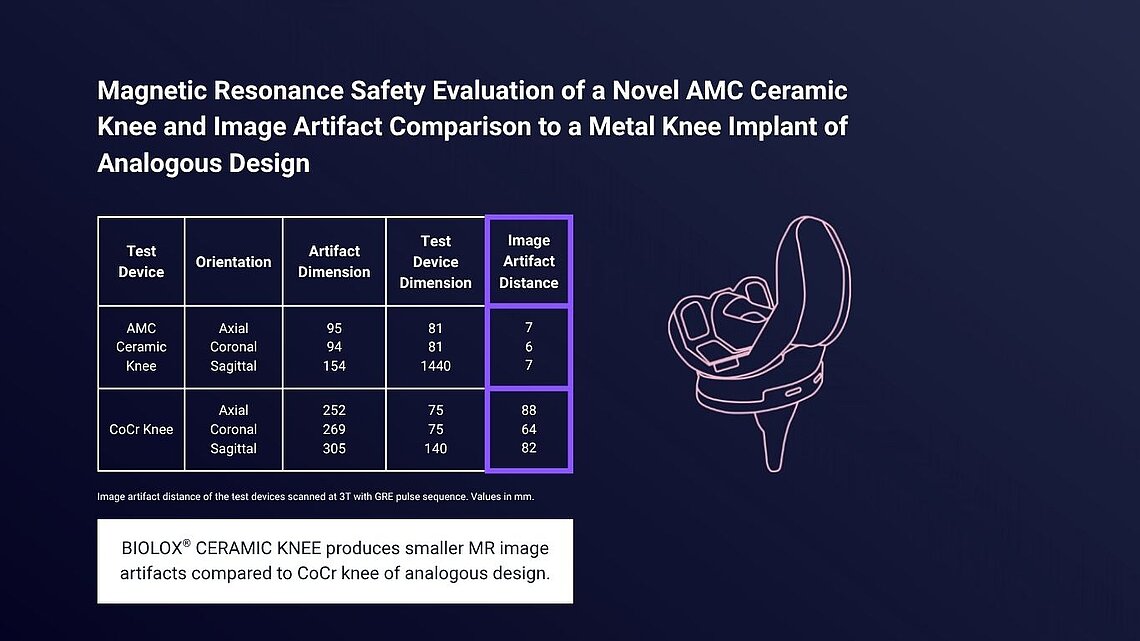
MRI can help answer the key questions: infection, osteolysis, adverse local tissue reactions, or unexplained pain. Around metal components, however, susceptibility artifact can hide exactly the region that matters.
Dr. Yvonne Mödinger et al. (2023) kept this in mind in their in vitro MRI research on the BIOLOX® CERAMIC KNEE, an alumina matrix composite (AMC) knee made with BIOLOX®delta ceramic technology.
| ➡️ In a 3T MRI comparison against an analogous cobalt-chromium (CoCr) knee (ASTM F2119), the AMC knee produced maximum MR image artifact of 7 mm on gradient echo, versus 88 mm for the CoCr knee (6 vs. 69 mm on spin echo). ➡️ The driver is magnetic susceptibility: 2 ppm for AMC versus 820–2885 ppm for the CoCr alloys tested. ➡️ The AMC knee also showed no magnetically induced displacement or torque and <1 °C RF-induced heating over 15 minutes at 3T. ➡️ Based on these results, the authors conclude that the AMC ceramic knee can be regarded as MR Safe under ASTM F2503-20. |
Clinically, lower-susceptibility materials leave more of the peri-implant region interpretable on MRI and reduce reliance on metal artifact reduction techniques whose gains are limited at 3T. For relatively younger, active TKA recipients, who have the highest lifetime revision risk and are most likely to be re-imaged, that cumulative diagnostic yield adds up.
📖 Mödinger Y, Gross DC, Porporati AA, Anttila ED, Baker GM. Magnetic resonance safety evaluation of a novel alumina matrix composite ceramic knee and image artifact comparison to a metal knee implant of analogous design. Arthroplasty Today, 22, 101170. doi: 10.1016/j.artd.2023.101170
Knee implants made of BIOLOX®delta are either registered by CeramTec GmbH’s customers or are under development and not approved by any regulatory authority or notified body.
This post reflects CeramTec’s summary of a peer-reviewed scientific publication and does not constitute clinical guidance, risk prediction for individual patients, or product-related recommendations. For product, safety, and risk information, always refer to the labeling of the legal manufacturer.