
2026 Heinz Mittelmeier Award honours research into liner adhesion in ceramic hip arthroplasty
Heidelberg research team recognized at DKOU 2026
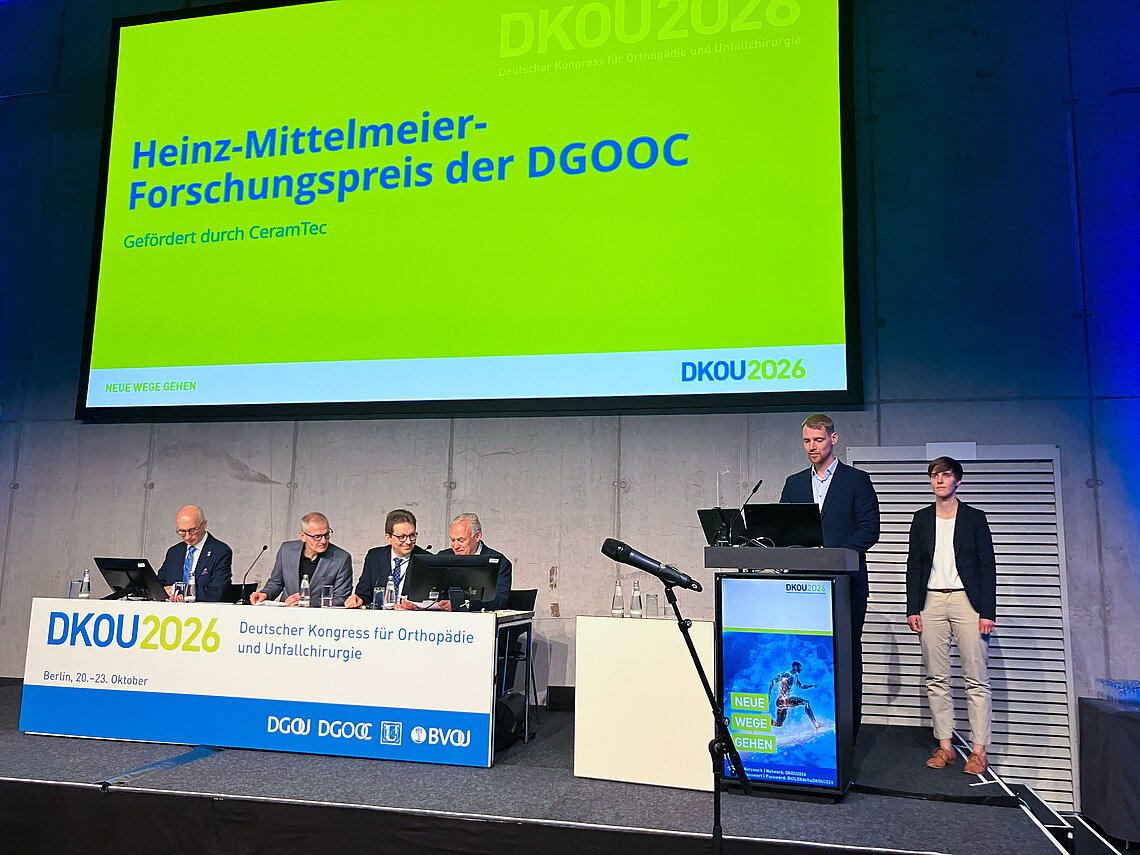
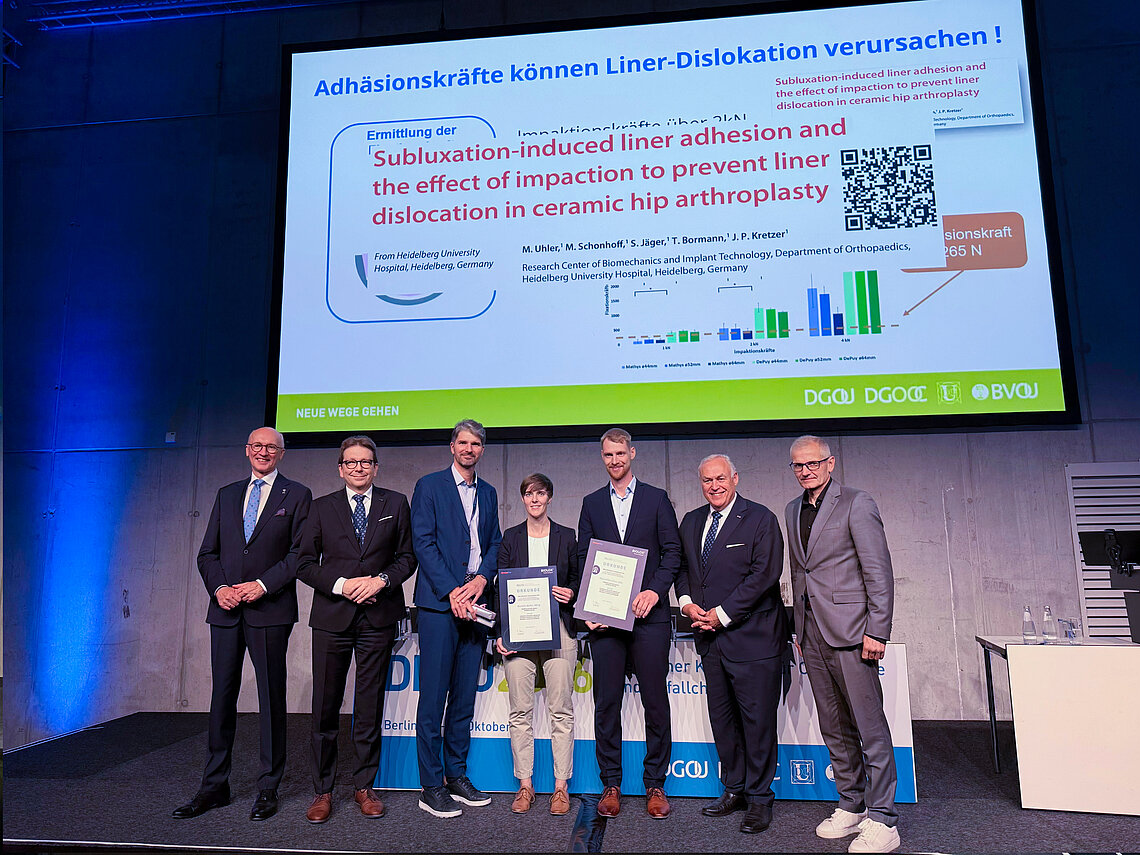
At DKOU 2026, the Heinz Mittelmeier Award was awarded to Research Associates Maximilian Uhler and Mareike Schonhoff of University Hospital Heidelberg (UKHD). The two researchers are part of the team led by Dr. J. Philippe Kretzer.
The prize recognises their study on subluxation-induced liner adhesion and the effect of impaction on preventing liner dislocation in ceramic-on-ceramic (CoC) total hip arthroplasty (THA).
Study focus: head-to-liner adhesion and liner fixation
The authors investigated whether adhesion between a ceramic femoral head and acetabular liner could contribute to liner extraction during a brief subluxation. During partial separation of the joint, a fluid film between the closely fitting ceramic surfaces may generate a suction-like adhesion effect. If this force exceeds the force retaining the liner in the cup, the liner may be pulled from its seat.
The study evaluated two ceramic systems: Mathys SeleXys with Ceramys® ceramic and DePuy Synthes Pinnacle with BIOLOX®delta ceramic. Tests were conducted with 28 mm and 36 mm heads.
The researchers measured:
- Head-to-liner adhesion at distraction speeds of 10–120 mm/s
- Liner fixation after assembly forces of 1, 2 and 4 kN
- Push-out forces following ASTM F1820-13
Key findings from the publication
- Adhesion forces reached up to 265.7 N.
- With 28 mm heads, adhesion increased with distraction speed and differed significantly between the two systems. With 36 mm heads, adhesion remained similar across speeds and systems.
- After 1 kN assembly, mean liner fixation forces ranged from 95.6 N to 385.5 N. In some cases, these values were lower than the adhesion forces measured.
- Fixation strength increased with assembly force and was consistently higher in the system with the smaller taper angle: DePuy Synthes Pinnacle (5.0°) compared with Mathys SeleXys (9.5°).
Clinical relevance and authors’ recommendation
The authors refer to cadaver studies indicating that traction forces of 200–250 N can separate the hip joint by several millimetres. Such forces may plausibly occur during intraoperative stability testing or early physiotherapy.
For the implant systems studied, the authors recommend impacting the liner with more than 2 kN to reduce the potential for adhesion-related liner extraction. They also caution that excessive force may contribute to ceramic fracture or cup loosening, and that these thresholds may differ for other implant systems.
CeramTec congratulates Maximilian Uhler, Mareike Schonhoff and the entire Heidelberg team on this recognition.
Original Publication:Uhler M, Schonhoff M, Jäger S, Bormann T, Kretzer JP. Subluxation-induced liner adhesion and the effect of impaction to prevent liner dislocation in ceramic hip arthroplasty. Bone & Joint Research. 2026;15(6):696–704. doi: 10.1302/2046-3758.156.BJR-2025-0615.R1
Please check the regulatory approval status of relevant products in your country.
Get to know the previous award winners and their research.